
Betting explained
Live Betting Explained and How the Prices Move
Live betting is betting on an event after it has started, at prices that change with every minute and every incident. The clock moves those prices as surely as a goal does, and the book controls when your bet is accepted.
 By
By

What live betting is
Live betting, also called in-play or in-running betting, is any bet struck after the event has started and before it finishes. The market stays open through the match, the book reprices it continuously, and the prices you see are a running estimate of what happens next. In-play coverage on the sports you follow is one of the market tests in our betting site ranking.
Almost every sport a book covers pre-match is also offered live. Football, tennis, cricket and basketball carry the deepest live markets, and horse racing is bet in running on the exchanges while the race is on.
- The market is open while the event is played
- Prices update after every incident and as time runs down
- Bets are accepted after a short delay, and only if the price has not moved
How a live bet is placed and accepted
A live bet goes through one more step than a pre-match bet, and that step is where most of the frustration lives.
-
You pick a price
The price on screen is the one the book is offering at that moment, taken from its live data feed.
-
The bet waits
The book holds the bet for a few seconds before accepting it, long enough to see whether anything has just happened on the pitch.
-
It is accepted, repriced or refused
If the price is unchanged the bet stands. If it has moved you are offered the new price or the bet is rejected, and if the market has been suspended in that window the bet does not go on at all.
Why live odds move
Two things move a live price: incidents and time. Incidents are the obvious part, a goal, a red card, a break of serve. Time is the part punters underestimate, because a market that needs something to happen gets less likely with every minute in which it does not.
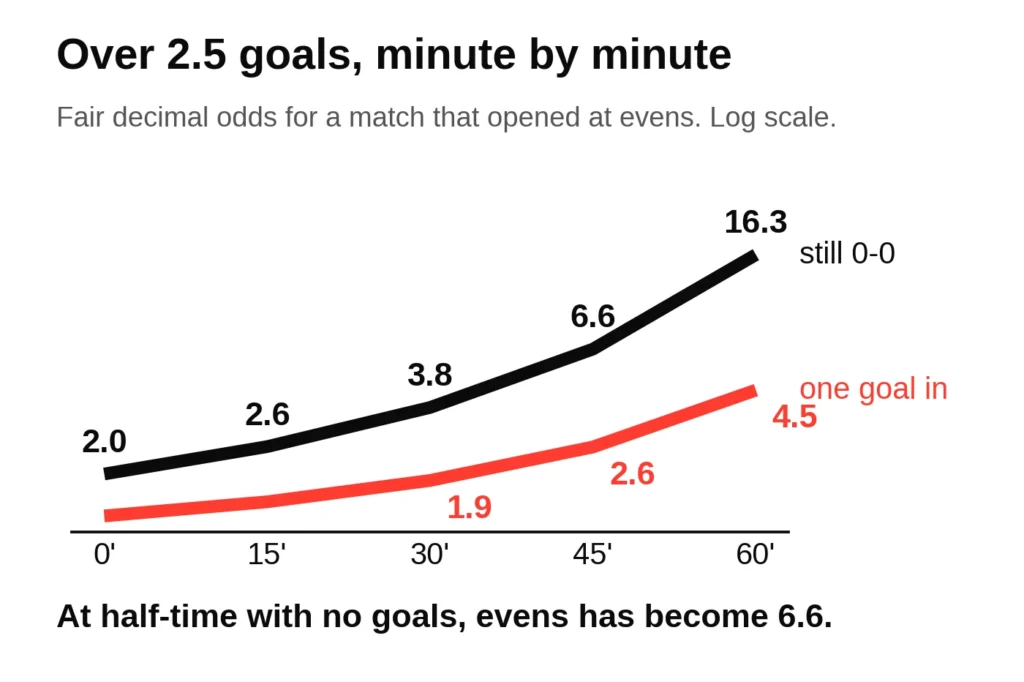
Take over 2.5 goals in a match priced at evens before kick-off. If the game stays goalless, the fair price drifts steadily without a single incident, because the match has less time left to produce three goals.
- Still 0-0 at 30 minutes, the fair price is 3.8
- Still 0-0 at half-time, it is 6.6
- Still 0-0 on the hour, it is 16.3
A goal resets the clock the other way: one goal in and the same market at half-time is 2.6 instead of 6.6.
Suspended markets
When something decisive is about to happen, the book stops taking bets. A penalty awarded, a video review, a dangerous free kick, a break point in tennis: the market is suspended, bets in the acceptance window are refused, and it reopens at new prices once the outcome is known.
Suspensions protect the book from being picked off by anyone who sees the incident first. For the punter, they mean the most interesting moments of a match are exactly the moments you cannot bet on.

The bet delay and why it exists
The acceptance delay is the few seconds between pressing the button and the bet standing. Its job is to close the gap between what the book knows and what the fastest punter knows: people at the ground, and anyone on a faster data feed, can see an incident before the price reacts. Betting on that gap is called courtsiding, a term that comes from tennis.
Licensed British books use delays as part of the in-play integrity controls the Gambling Commission expects. Nothing obliges them to make those delays equal, and a delay can be longer on some sports, some markets and some accounts than on others.

Streaming, data and the latency gap
A television picture is usually several seconds behind the pitch, and a phone stream can be further behind than that. The book prices from a data feed that is faster than both. If you bet on what you are watching, you are often betting on something the price has already absorbed.
- Broadcast pictures run behind the live data the book prices from
- Streams inside a betting app are rarely faster than the feed behind the prices
- Stats and match trackers update from the same data, which makes them the more useful screen for timing a bet, and the best betting apps put them beside the market
The practical rule: in running, the edge is in reading the game better, not in seeing it sooner. Nobody watching from the sofa sees it sooner.

Live betting markets
Football carries the widest live menu, and most of it is the pre-match menu repriced every minute. On football betting the markets that move most in running are the ones tied to time and goals.
- Match result, double chance and draw no bet, repriced after every goal and red card
- Over and under goals and the next goal, driven mostly by the clock
- Asian handicap in play, where the handicap line moves as well as the price
- Cards and corners, which reprice on every foul and every attack
- Tennis next game and set betting, cricket session markets, and racing in running on the exchanges
Do live bets pay more
A live price is not more generous than a pre-match one. It usually carries more margin, because the book is pricing faster, with thinner information, against customers who may be better informed at that moment. The overround on live markets is typically at its widest on the minor leagues and sports where the book has the least data.
What live betting does offer is a different price, not a better one. A team that concedes early drifts, a favourite that goes a set down in tennis gets longer, and a punter who reads the game better than the model can find a price that pre-match never offered.
Cashing out in running
Cash out is offered live on most markets, and it is the book buying your bet back at a price it sets. The figure carries its own margin and is always below the fair value of the bet you hold. The arithmetic is the same whether the bet is a single or an accumulator bet, and settling early never beats the fair value of letting it run.
Live betting and account limits
Live markets are where books are most careful about who they take money from. A punter who backs early goals, strikes before the price reacts or takes every drifting favourite that comes back is winning in the place the book prices worst, and a stake factor, a cut to the most the book will take from you, can arrive on live markets first. The Gambling Commission data on how often bookmakers restrict winners shows how common that is.
Books licensed outside Great Britain work to a different commercial model on live markets as elsewhere, and do not factor stakes in the same way or at the same speed.
Live betting questions answered
Betting on an event after it has started and before it finishes, at prices the book updates throughout.
Open the live or in-play section, pick a market and a price, and place the bet. It is held for a few seconds and accepted if the price has not moved.
No. Live prices usually carry more margin than pre-match ones. They can be different, which is not the same as better.
The price moved or the market was suspended during the acceptance delay. The book offers the new price or refuses the bet.
A few seconds, set by the book, and it can differ by sport, by market and by account.
To stop bets going on while something decisive is happening, such as a penalty, a review or a break point, until the price has been updated.
Usually, yes, at a figure the book calculates. It is always below the fair value of the bet you are holding.
It is different. Pre-match prices are keener; live prices move with the game, and they reward reading a match better than the book does.