 By
By
Top Choice
1

Gamble Gorilla
- Exclusive Free Bet Offer
- In-Play Live Betting
- Broad Sports Coverage
Bonus
WELCOME SPORTS FREEBET
UP TO £100
FREEBET
UP TO £100
FREEBET

Cricket
Cricket betting is cheap on the match and expensive almost everywhere else, so the book you use and the market you pick matter more than any tip. We read the prices at every book on 13 cricket markets, from one-day internationals to the next Ashes and the top batsman, and ranked books on price, depth, settlement rules and how they treat a winning account.













A cricket match can run for three hours or five days, and the markets change with the format. We price the match first, then the markets around it, then the rules and the account behaviour that decide whether a winning bet is paid and whether the next one is accepted.
We read every price on 13 cricket markets between 28 and 30 September 2026, at every book that priced the whole market, and added up the chance each price implies. A fair market totals 100 per cent; everything above that is the margin you pay.
The match itself is keenly priced. A two-way one-day international ran at about 106 per cent at the typical book, a T20 match at about 106.5. Move away from the match and the margin climbs fast: a tournament winner costs three to four times as much, and the top batsman market costs ten times as much.
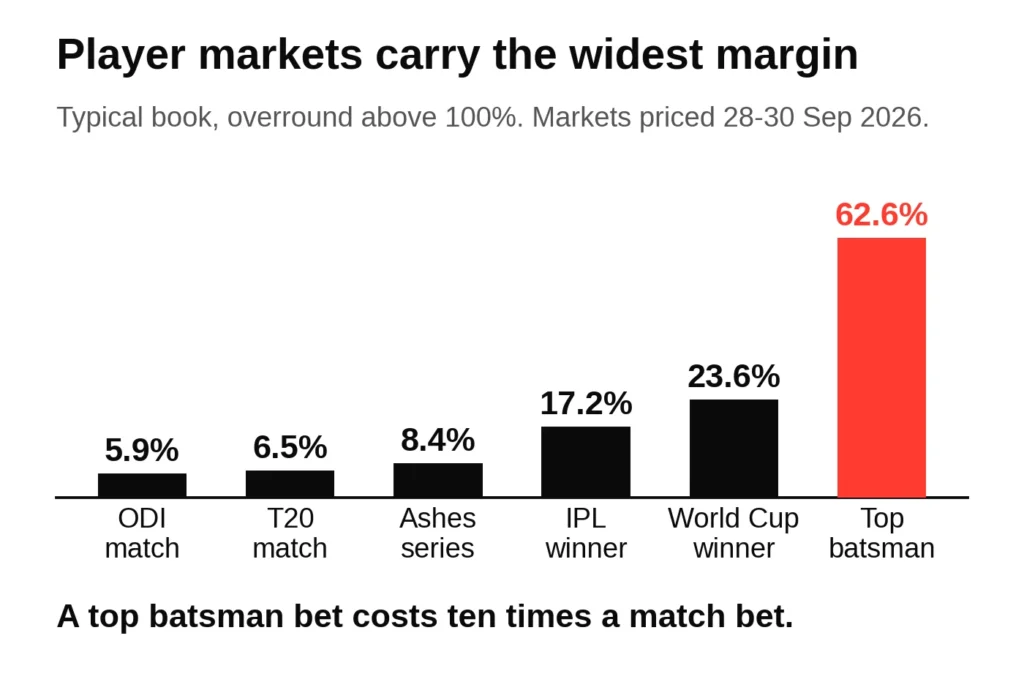
A top batsman market lists 30 or more players, and only one of them can win it. The book shades every price a little shorter than its real chance, and a few points taken off each of 30 players adds up to more than half the market. The overround works the same way on any market with many runners; cricket simply puts a match priced at 6 per cent next to a player market priced at 60.
Books agree on the favourite and disagree on everything else. Taking the longest price on each side, wherever it was, turned markets that cost 9 to 12 per cent at the widest book into ones that cost under 3 per cent, on the three markets in the chart. On the Ashes the best prices across 12 books added up to just 100.8 per cent, close to a fair market.
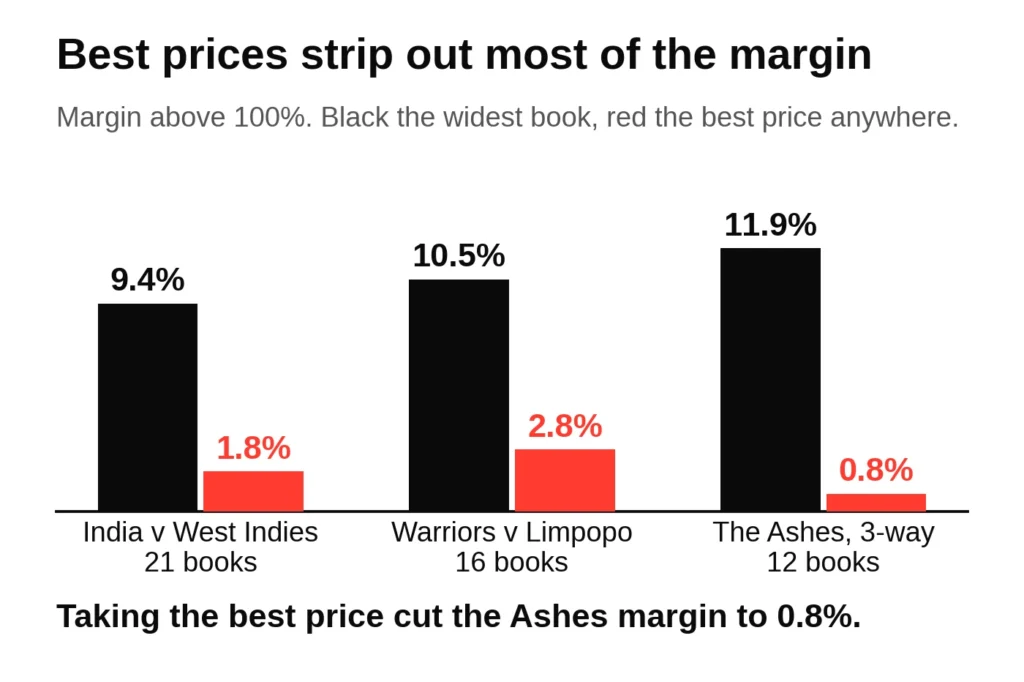
Most of the gap sits on the outsider. In India against West Indies every book had India between 1/25 and 1/9, a spread of a few pence on a winning pound. West Indies ranged from 5/1 to 15/2.
If you back outsiders, and the draw in Test cricket is usually one, the book you use decides more of your return than your opinion does.
A Test runs for up to five days and has three results: either side wins, or the match is drawn when time runs out before a result. That third outcome makes Test match odds a three-way market, like a football match, and it moves more than any other price in cricket.

If you think a side will not lose but are not sure it will win, draw no bet backs it with the stake returned if the match is drawn, at a shorter price than the straight win. A tie is something else: both sides finish level on runs with the last batter out. It has happened twice in more than 2,500 Tests, and most books settle a tied Test by dead heat rules, paying half the stake on each side at full odds and settling draw bets as losers.
Limited-overs cricket always produces a winner or a tie, so match betting is a two-way market with a much lower margin than a Test. The shorter the format, the less the favourite can control, and prices in T20 and The Hundred sit closer together than in one-day cricket.
The toss matters more in short cricket than in long. A side that chooses to chase knows its target, and on a dewy evening the chasing side is often shorter in the market before a ball is bowled.
Cricket is the one major sport where the weather can decide the result, change the target or end the match with no result at all. Settlement rules differ between books in the detail, so these are the common cases and how most books treat them.

| Rain-reduced limited-overs match | Settled on the official result, including a target revised by the Duckworth-Lewis-Stern method |
|---|---|
| Tie decided by a super over | Most books settle match bets on the super over winner, where the competition uses one |
| Tie with no super over | Dead heat rules: half the stake on each side at full odds |
| Abandoned with no result | Match bets are void and stakes returned |
| Drawn Test or first-class match | Player bets such as top batsman usually stand only if at least 200 overs were bowled |
| Player bets and the starting XI | A player named in the XI usually stands even if he does not bat; a player left out is void |
Top batsman asks who scores the most runs in the match or for one side. It is the most popular cricket bet after the match itself, and it is where the margin is widest: the two full top batsman markets we read ran at 157.5 to 171.4 per cent.
Because the margin on player markets is so wide, the gap between books is wide too. The longest price on each player at any book cut one top batsman market from 171 to 153 per cent.

Books price almost every number on a cricket scorecard, and the lines are where a punter who follows a ground or a pitch can find an edge.
Runs markets are also sold as spreads, where the payout grows with every run above or below the line. Spread betting on sport works differently from fixed odds and can cost more than the stake.
Cricket suits betting while the match is live better than most sports: there is a pause after every ball, a match can swing on one wicket, and a Test gives you five days of prices.
A tournament winner market lists every team, and the margin grows with the field. Books disagree most on the teams at long prices, so the best price across books is far tighter than any single book.
Money on an outright is tied up until the tournament ends, often for months. The longer it is tied up, the more the price needs to beat what you could get nearer the start.
British cricket runs through the summer, and the winter belongs to tours abroad and the franchise leagues, so there is cricket to bet on in every month of the year.
Most cricket tips are opinions on who will win. The things that change a price before the market has caught up are more specific, and they are free to check.
Most cricket bets are now placed on a phone, and the in-play markets are built for it. What separates cricket betting apps is not the design but how quickly they reopen after each ball, whether they carry the full player markets from the desktop site, and whether they stream or only show a scoreboard.
Player markets and in-play cricket are where books limit winning accounts first, because those are the markets where their prices are weakest. A stake factored down to a few pounds on top batsman is a common outcome for anyone who takes early prices. Our guide to why bookmakers limit winning accounts explains how it works.
A UK-licensed book also has to verify your identity before you bet, and run a financial vulnerability check once net deposits pass 150 pounds in 30 days. Books licensed outside Great Britain work to a different model: fewer checks before the first bet, and a commercial reason to keep a winning cricket account open.
The right book depends on the cricket you bet.
The one with the lowest margin on the match, the widest player markets, clear rules for ties and rain, and a record of keeping winning accounts open. The ranking at the top of this page is built on those.
Match bets settle on the official result, including rain-reduced targets and super overs. Abandoned matches are void. In drawn Tests, most books require 200 overs to be bowled for player bets to stand.
A bet on either side loses and a bet on the draw wins. A draw no bet stake is returned.
Most books apply dead heat rules: half the stake on each side at full odds, and bets on the draw lose. It has happened twice in Test history.
For most punters, no, because every price carries a margin. The ones who make it pay take the best price across books, avoid the widest markets and bet on information the price has not caught up with.
A bet on the player who scores the most runs, either in the match or for one side. Ties are settled by dead heat.
The market has three outcomes, either side or the draw, and it stays open for all five days, with session and innings markets alongside.
Yes. Books price the match and most side markets live, suspending for each ball and reopening after it.