What “best betting site” really means
Type “best betting sites” into a search engine and you will be met with pages of star ratings, podium positions and flashing welcome offers. Most of those pages are paid to send you somewhere. That does not automatically make them wrong, but it does mean the order you see is rarely a neutral judgement of which bookmaker will treat you well over a season of Saturday accumulators and midweek racing.
A betting site can only be “best” relative to what you actually do. Someone who places a £5 each-way bet on the Grand National once a year needs very different things from someone who trades in-play tennis every evening. The first person cares about a simple sign-up, a clear place terms display and a quick withdrawal. The second cares about price margins measured in fractions of a percent, stable live streaming and whether their account will be restricted after a few winning weeks.
So rather than hand you a list, this guide gives you the criteria. We explain how the regulatory system in Great Britain works, how to read odds and spot a thin or fat margin, what to look for in payment and verification processes, how promotions are now regulated, and which safer gambling tools every licensed site must offer. By the end you should be able to open any bookmaker's website and judge it in about ten minutes.
The short version
A good UK betting site is licensed by the Gambling Commission, prices its markets competitively, pays out promptly to the method you deposited with, writes its promotional terms in plain English and makes limits, time-outs and self-exclusion easy to find. Everything else is preference.
Why this guide contains no rankings or links
Dubaussi does not rank bookmakers, and there are no affiliate links anywhere on this site. That is a deliberate choice. When a comparison site earns a share of the money its readers lose, or a flat fee for every new account, there is an unavoidable pull towards promoting whichever brand pays the most rather than whichever brand suits the reader.
We would rather teach the method than sell the answer. Bookmakers also change: margins move, ownership changes, payment partners come and go, and a site that was excellent two years ago may have tightened its terms since. A checklist you can apply yourself stays useful long after any ranking goes stale.
Where we mention categories of operator, we describe them generically: large high-street brands with retail shops, online-only sportsbooks, betting exchanges and specialist racing firms. Each has typical strengths and weaknesses, and understanding those patterns is more useful than a name. You can read more about our editorial approach and the people behind the site on our about page.
The legal framework: how betting is regulated in Great Britain
Betting in Great Britain is governed by the Gambling Act 2005, which created the Gambling Commission as the regulator for England, Scotland and Wales. Northern Ireland has its own separate legislation, so some of the detail below applies differently there. Under the 2005 Act, any company offering remote betting to consumers in Great Britain must hold a Commission licence, regardless of where the company itself is based.
That point matters. It means a sportsbook headquartered in Gibraltar, Malta or the Isle of Man still has to meet British rules when it takes bets from British customers. The licence comes with the Licence Conditions and Codes of Practice, a long document covering everything from how customer funds are protected to how advertising must be worded and when an operator must step in if a customer shows signs of harm.
The rules have tightened considerably over the past few years. Credit card gambling was banned in April 2020. Participation in the GAMSTOP self-exclusion scheme became mandatory for online operators the same year. Age verification must be completed before a customer can deposit or place a bet. More recently, a statutory levy funds research, prevention and treatment, and new rules on promotions and financial risk checks have followed the government's 2023 white paper on gambling reform.
| Rule | What it means for you |
|---|---|
| Minimum age 18 | Age and identity must be verified before you can deposit or bet. |
| No credit cards | Debit cards, bank transfers and e-wallets only; e-wallets cannot be loaded by credit card for gambling. |
| GAMSTOP participation | One national self-exclusion covers every online GB licensee. |
| Approved dispute resolution | Unresolved complaints can go to an independent ADR provider free of charge. |
| Wagering cap of 10x | Promotional wagering requirements cannot exceed ten times the bonus. |
| Customer interaction duties | Operators must monitor for signs of harm and act on them. |
You can read the Commission's own guidance for the public on its public and players pages, which are written for consumers rather than industry.
Licence checks in practice
Every legitimate UK betting site displays its Gambling Commission account number, usually in the footer next to the regulator's logo. A logo on its own proves nothing, because images are easy to copy. The number is what you verify.
- Find the account number. It is normally a four to six digit figure in the site footer or the terms and conditions.
- Search the public register. Enter the number or company name on the Gambling Commission public register.
- Check the status. The licence should be listed as active, not suspended, surrendered or revoked.
- Check the activities. For a sportsbook you want remote general betting or remote pool betting activities listed.
- Check the domain. The register lists the trading names and domains attached to each licence. The address in your browser should be one of them.
That last step is the one people skip, and it is the one that catches clone sites. Fraudsters sometimes copy the design and licence number of a real operator on a lookalike domain. If the web address is not on the register, walk away.
The register also records regulatory action. A large fine is not necessarily a reason to avoid an operator, as many of the biggest firms have been penalised for past failings in anti-money laundering or safer gambling controls, but it does tell you what the regulator found and how the company responded. Our dedicated guide to UKGC licence checks walks through the register screen by screen and explains how to read enforcement notices.
Odds and margins: where value really lives
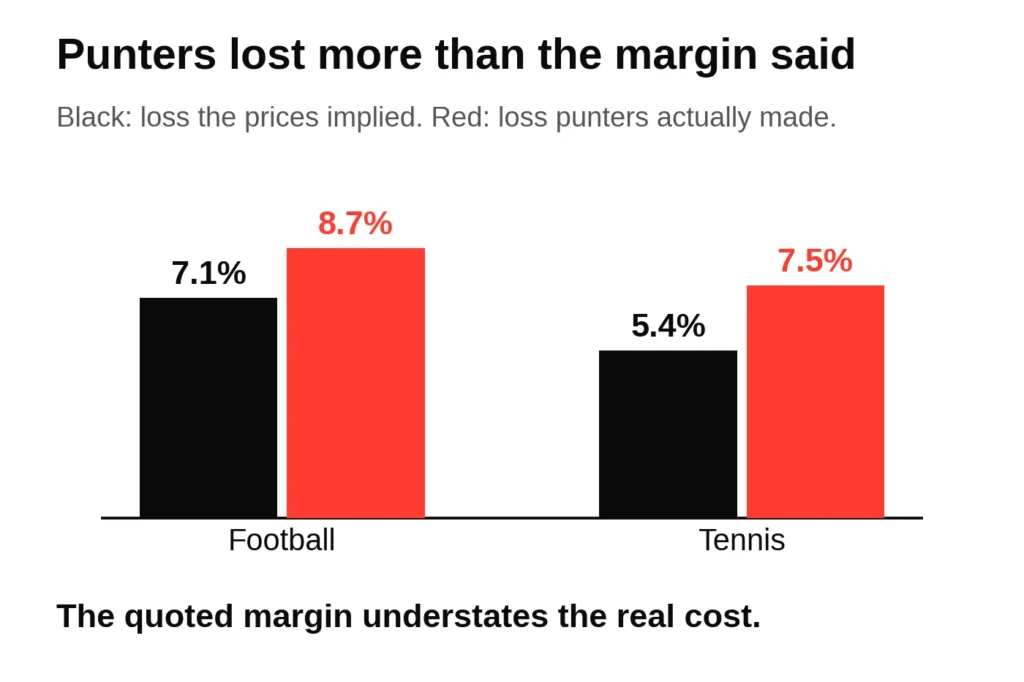
If you bet regularly, price matters more than any welcome offer. A bookmaker's odds contain a built-in margin, sometimes called the overround or vig, which is how the firm makes money regardless of the result. Two sites can offer the same football match with margins of 3% and 8%, and over hundreds of bets that difference compounds into real money.
The easiest way to see a margin is to convert every price in a market to an implied probability and add them up. Decimal odds convert by dividing one by the price: odds of 2.00 imply a 50% chance, odds of 4.00 imply 25%. In a perfectly fair two-way market the probabilities would add to exactly 100%. Anything above that is the bookmaker's edge.
| Outcome | Site A price | Site A implied | Site B price | Site B implied |
|---|---|---|---|---|
| Player 1 wins | 1.91 | 52.4% | 1.83 | 54.6% |
| Player 2 wins | 1.91 | 52.4% | 1.83 | 54.6% |
| Total book | 104.7% | 109.3% |
Site A is taking a margin of roughly 4.7% on this market; Site B nearly double that. If you staked £10 on every one of 300 similar bets a year, the gap between those margins is worth around £120 in expected value. That is money no sign-up bonus will make up for.
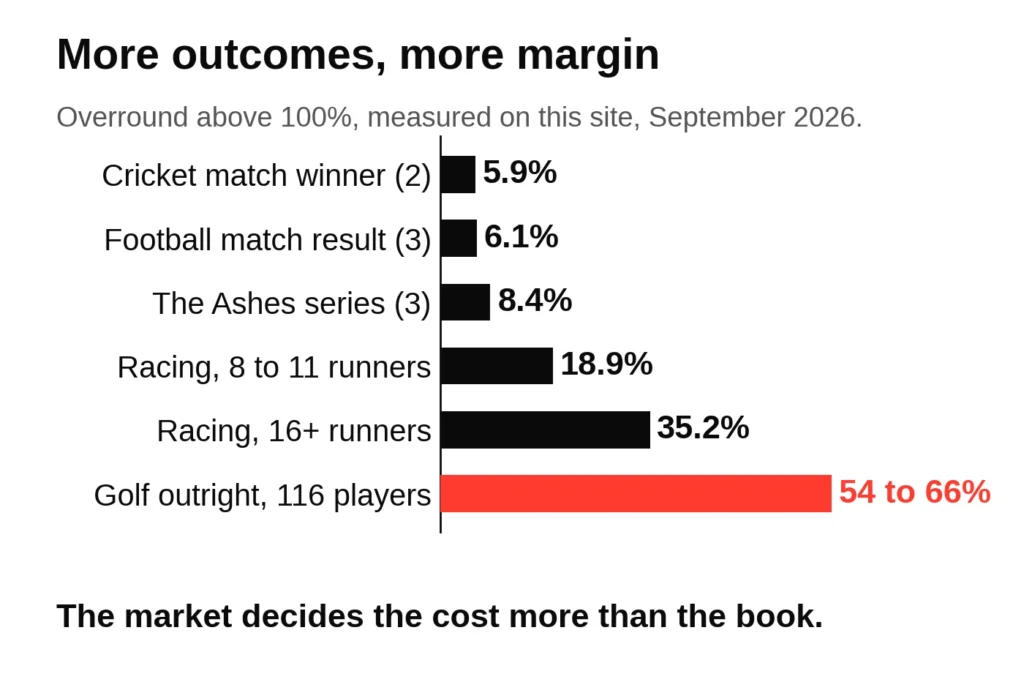
Margins vary by sport and market type. Top-flight football match odds are usually the tightest; lower-league matches, novelty markets and multi-leg bet builders are usually the widest. Betting exchanges work differently, charging commission on net winnings instead. Our full explainer on how betting odds work covers fractional, decimal and American formats, implied probability, overround calculations and why prices move before kick-off.
Licensed versus unlicensed sites compared
Offshore sites that are not licensed in Great Britain still advertise to UK customers, often promising bigger bonuses, fewer checks and no GAMSTOP restrictions. It is worth being clear-eyed about what you give up in exchange.
| Protection | GB-licensed site | Unlicensed site |
|---|---|---|
| Independent complaints route | Approved ADR provider, free to you | Usually none recognised in the UK |
| Self-exclusion | GAMSTOP applies automatically | Not bound by GAMSTOP |
| Promotional terms | Wagering capped at 10x, fairness rules apply | Any terms the operator chooses |
| Customer funds disclosure | Protection level must be stated | No UK requirement |
| Advertising standards | ASA and CAP codes enforced | Largely outside UK enforcement |
| Harm monitoring | Mandatory customer interaction duties | Varies, often minimal |
The practical risk is simple: if an unlicensed operator refuses to pay you, freezes your balance or changes its terms after the fact, there is very little you can do about it from the UK. For anyone who has self-excluded, these sites also remove the safety net that GAMSTOP was designed to provide. Our view is straightforward: if a site cannot show you an active Gambling Commission licence covering its domain, it should not be on your shortlist.
Market depth and sports coverage
The best betting site for you will cover the sports you actually follow, to the depth you actually want. Almost every UK bookmaker offers the Premier League, major horse racing meetings and Grand Slam tennis. Differences appear further down the card.
If you follow the National League, Scottish Championship, county cricket, darts floor tournaments or all-weather racing at Wolverhampton on a Tuesday night, check whether a site prices those events at all, how early prices appear, and how many markets are available beyond the match result. Some firms offer hundreds of markets on a big football match but only a single win market on a lower-league fixture.
Horse racing specifics
Racing punters should look for a few features that make a measurable difference. Best Odds Guaranteed means that if you take an early price and the starting price is bigger, you are paid at the bigger price. It is common on UK and Irish racing but usually comes with conditions: it may start only from a certain time on race day, cap the extra winnings, or be withdrawn from accounts the firm considers too successful. Extra places on big handicaps and clear display of each-way terms (the fraction of the odds and the number of places paid) also matter.
Football and multi-leg markets
For football, look at the range of player and statistical markets, how bet builders are priced, and whether accumulator insurance or bonuses carry sensible terms. Bet builders are popular but typically carry some of the widest margins in the sportsbook, because the site prices correlated outcomes and adds a margin on each leg.
Bet types every UK punter should understand
The way a bet is structured often matters as much as the odds. A few minutes understanding the main bet types will stop you placing something you did not intend.
| Bet type | How it works | Watch out for |
|---|---|---|
| Single | One selection, one outcome. | Nothing hidden; the cleanest way to bet. |
| Each-way | Two bets: one to win, one to place. Place part pays a fraction of the odds. | Place terms vary: 1/4 or 1/5 odds, 2 to 5+ places. |
| Accumulator | Several selections; all must win. | Margins multiply across legs. |
| Bet builder | Several outcomes in one event combined. | Correlated pricing, usually high margin. |
| Patent / Lucky 15 | Full-cover multiples across three or four selections. | Total stake is several times the unit stake. |
| Forecast / tricast | Predict the first two or three finishers in order. | Dividends set by formula, not fixed odds. |
Full-cover bets such as a Lucky 15 catch people out more than anything else. A £1 Lucky 15 is fifteen separate £1 bets, so it costs £15 in total, or £30 if you choose each-way. Good betting sites make the total stake obvious on the bet slip before you confirm. If a site's bet slip leaves you unsure what you are about to pay, treat that as a design failure worth marking down.
Promotions and free bets under the 2026 rules
Welcome offers are where most betting-site marketing money goes, and they are where the rules have changed most recently. From January 2026 the Gambling Commission capped wagering requirements on promotions at ten times the bonus amount and banned promotions that mix different gambling products, such as an offer requiring you to bet on football to unlock free casino spins.
That has made sports offers simpler. Most UK welcome offers now take the form of “bet £10, get £X in free bets”. The details that decide whether such an offer is worth anything are almost always in the terms rather than the headline:
- Stake not returned. Winnings from a free bet usually exclude the free bet stake itself, so a £10 free bet at evens returns £10, not £20.
- Minimum odds. Qualifying bets and free bets commonly require odds of 1/2 (1.50) or bigger.
- Expiry. Free bets often expire within seven days of being credited.
- Market restrictions. Some free bets can only be used on specific sports or bet types.
- Payment exclusions. Deposits by certain e-wallets are sometimes excluded from qualifying.
A practical rule
Judge an offer by the value you would realistically extract after the terms, not the number in the banner. A small offer with plain terms and no minimum odds can be worth more than a large one split into several restricted tokens.
Ongoing promotions such as price boosts, acca insurance and loyalty rewards can be more valuable than a one-off welcome offer if you bet regularly, but they deserve the same scrutiny. Our detailed guide to free bet offers and promotional terms includes worked examples of how much a typical offer is actually worth.
Payments and withdrawals
How a site handles your money tells you more about it than almost anything else. Deposits are easy everywhere, because every operator wants them to be. Withdrawals are where the differences show.
In Great Britain the usual methods are Visa and Mastercard debit cards, open banking or instant bank transfer, Apple Pay and Google Pay, and e-wallets such as PayPal. Credit cards are banned for gambling, and the Commission also stops e-wallets from being funded by credit card for this purpose. Most operators apply a closed-loop policy, returning withdrawals to the method you deposited with to prevent money laundering.
| Method | Typical time to reach you | Notes |
|---|---|---|
| Debit card (Visa Direct / Mastercard fast funds) | Minutes to a few hours | Depends on card issuer support. |
| Standard debit card refund | 1 to 5 working days | Older rails, still common. |
| Open banking / bank transfer | Same day to 2 working days | Faster Payments usually near-instant. |
| PayPal and other e-wallets | Within 24 hours | Sometimes excluded from promotions. |
The “pending period”, the time between requesting a withdrawal and the operator approving it, varies from instant to several days. Reverse withdrawals, where you could cancel a pending cash-out and gamble the money again, are no longer permitted for GB licensees. Look for sites that publish their processing times clearly and do not charge withdrawal fees. Callum's guide to betting account payments covers deposit limits, closed-loop rules, fees and what to do if a payout is delayed.
Verification and affordability checks
Every GB-licensed operator must verify your name, address and date of birth before you can deposit or bet. For most people this happens automatically in seconds, using credit reference and electoral roll data. If the automatic check fails, you will be asked to upload documents: typically photo ID such as a passport or driving licence, and proof of address such as a recent utility bill or bank statement.
Separately, operators have anti-money laundering duties and obligations to check that customers are not spending more than they can afford. Following the 2023 white paper, the Commission introduced light-touch financial vulnerability checks at modest net deposit levels, using public data such as county court judgments, with more detailed checks reserved for customers spending far larger sums. Requests for payslips, bank statements or evidence of savings usually arrive after significant deposits.
These checks irritate some customers, and a good operator explains why it is asking and what it needs rather than simply freezing an account. Signs of a well-run site include clear upload instructions, a stated timeframe for review, and the ability to complete checks before you want to withdraw rather than at the moment of your biggest win.
Protect your documents
Only upload identity documents through the operator's secure account area, never by email or social media message. Legitimate operators will not ask for your online banking password or one-time passcodes.
In-play betting and mobile apps
Most UK bets are now placed on a phone, and a large share are placed in-play, while the event is under way. That makes the quality of the app and the live betting engine a genuine differentiator rather than a nice extra.
When judging in-play betting, look at the delay between a bet being submitted and accepted, how often bets are rejected or re-priced, whether live streaming is available and what it requires (many racing streams need a funded account or a bet on the race), and how clearly the app shows suspended markets. Cash out, the option to settle a bet early for a price set by the operator, is widely available; remember that the cash-out figure includes a margin in the bookmaker's favour.
For apps specifically, check that the app is published by the licensed operator itself in the official App Store or Google Play, that biometric login is available, and that safer gambling tools such as deposit limits and time-outs can be set from inside the app rather than only on the desktop site. Our in-play and mobile betting guide explains live pricing, bet delays, cash out maths and the specific risks of fast, repeated in-play betting.
In-play betting is also the format most closely associated with loss of control, because the pace is fast and there is always another market opening. If you bet live, a session reminder and a deposit limit are worth setting before the match begins.
Cash out, bet limits and account restrictions
One aspect of UK sportsbooks rarely mentioned in their marketing is that they can limit how much you are allowed to stake. Bookmakers manage risk account by account, and customers who consistently beat the closing price, take advantage of promotions or bet on markets the firm prices weakly can find their maximum stakes reduced to a few pounds. Punters often call this being “gubbed”.
Operators are entitled to do this under their terms, and it is not a regulatory breach. It does, however, matter when choosing where to bet. If you intend to bet in a disciplined, value-seeking way, a betting exchange, where you bet against other customers rather than the house, is less likely to restrict you, though it will charge commission and may apply a premium charge to very successful accounts.
Cash out in context
Cash out lets you settle a bet early. It can be useful to lock in a profit or cut a loss, but the offered figure is priced with a margin, so using it routinely costs money over time. Some sites also suspend cash out during key moments of an event. Read the cash out rules in the terms before relying on the feature.
Void bets and palpable errors
Terms also allow operators to void bets struck at an obviously wrong price, known as palpable error. Fair operators define this narrowly and apply it consistently. Look for clear wording and a record of resolving disputes through the approved ADR route.
Customer support and complaints
Good support is invisible until you need it. Before depositing, look at which channels are available (live chat, email, phone), whether they operate at the times you bet, and whether the terms describe a clear complaints procedure.
Every GB licensee must have an internal complaints process and must refer unresolved disputes to an approved alternative dispute resolution (ADR) provider. The operator has up to eight weeks to resolve your complaint internally. After that, or once you receive a final response, you can take the dispute to the ADR provider named in the operator's terms. The most widely used is the Independent Betting Adjudication Service (IBAS). The service is free to you, and decisions are based on the operator's terms and the evidence.
- Complain in writing. Use the operator's formal complaints route and keep copies.
- Record the details. Note bet IDs, times, screenshots and any chat transcripts.
- Wait for the final response. Or for eight weeks to pass without resolution.
- Refer to ADR. Submit the dispute to the named ADR provider with your evidence.
The Gambling Commission does not resolve individual disputes, but it does want to hear if an operator fails to follow its own complaints procedure or will not refer you to ADR.
Safer gambling tools every site must offer
Every GB-licensed betting site must provide tools that help you stay in control. The quality varies, and how easy a site makes these tools to find says a lot about its priorities.
Tools inside your account
- Deposit limits: daily, weekly or monthly
- Reality checks and session reminders
- Time-outs from 24 hours to six weeks
- Account closure and operator-level self-exclusion
- Activity statements showing net deposits
Tools outside the site
- GAMSTOP national online self-exclusion
- Bank gambling blocks via your banking app
- Device-level blocking software
- Multi-operator self-exclusion for betting shops
- Free support via the National Gambling Helpline
Lowering a deposit limit takes effect immediately; raising one should involve a cooling-off period, typically 24 hours. That asymmetry is intentional. When you register with any site, setting a deposit limit before your first bet is one of the most effective protective steps available, because it is a decision made calmly rather than in the heat of a losing run.
Our responsible gambling page lists UK support organisations and explains the warning signs of harmful gambling in more detail.
Tax on betting winnings in the UK
For individual punters, betting winnings in the UK are free of tax. You do not pay income tax or capital gains tax on them, and you do not need to declare them. This has been the position since betting duty on stakes was abolished in 2001, when the tax burden shifted to operators.
Operators pay gambling duties to HMRC based on their gross profits from British customers. Changes to those duty rates, such as those announced in recent Budgets, can influence how generous bookmakers are with margins and promotions, but they are not deducted from your winnings.
A few points are worth knowing. Interest earned on money held in a betting account may be treated differently to winnings. If betting is part of a genuine trade or business, HMRC may view it differently, although this is rare for individuals. And if you move money won from betting into savings or investments, those later returns are taxed in the ordinary way. For personal circumstances, consult a qualified adviser or check guidance on GOV.UK.
Our ten-minute evaluation checklist
Here is the process we recommend for judging any betting site. Work through it in order; if a site fails an early step, there is no need to continue.
- Licence. Find the Gambling Commission account number and confirm the licence and domain on the public register.
- Terms. Open the general terms and check the maximum payout limits, palpable error wording and account restriction clauses.
- Prices. Compare two or three markets you bet on against other sites and work out the margin.
- Markets. Confirm the site covers your sports and leagues to the depth you want.
- Payments. Check supported deposit methods, stated withdrawal times and any fees.
- Verification. See what documents may be needed and whether checks can be completed in advance.
- Promotions. Read the full terms of any offer, including minimum odds, expiry and stake-returned rules.
- Safer gambling. Find deposit limits, time-outs and self-exclusion; they should take a couple of taps.
- Support. Test live chat with a simple question and note the response time.
- Complaints. Confirm the named ADR provider in the terms.
Apply the same checklist to every site you consider and the right choice for you usually becomes obvious. It will rarely be the one with the biggest banner.
Bankroll discipline and realistic expectations
No betting site, however well chosen, changes the underlying maths. The margin built into prices means that most people who bet lose money over time. Treating betting as paid entertainment, with a budget set in advance, is the realistic frame.
A simple bankroll approach works for most recreational punters. Decide a monthly amount you are genuinely comfortable losing, and set it as a deposit limit at every site you use. Keep individual stakes small relative to that budget, often in the region of 1% to 5% of it, so a losing run does not tempt you to chase. Record your bets, including the odds taken and the result; many people are surprised by what their records show after a few months.
- Never chase losses. Increasing stakes to win back money is the most common route into harm.
- Separate betting money. Do not use money meant for bills, rent or savings.
- Bet sober and rested. Alcohol and fatigue both weaken judgement.
- Take breaks. Use time-outs around big events if you tend to overdo it.
If it stops being fun
Call the National Gambling Helpline free on 0808 8020 133, available 24 hours a day, or visit GamCare for live chat support.
What is changing for UK betting sites in 2026
The UK betting market is still adjusting to the reforms that followed the 2023 gambling white paper. Several changes are shaping how betting sites look and behave this year.
Simpler promotions. The 10x wagering cap and the ban on mixed-product offers have pushed operators towards straightforward free bet deals and away from complicated multi-stage bonuses. Expect fewer “bet on football, get casino spins” offers and more emphasis on price boosts and loyalty schemes.
Financial risk checks. Light-touch checks on net deposits are now part of normal operations. Most customers never notice them, but higher spenders should expect more questions and should keep documents ready.
Statutory levy. Operators now pay a mandatory levy that funds research, prevention and treatment services, with NHS involvement in treatment. This is steadily changing how support services are commissioned and signposted.
Direct marketing consent. Rules requiring customers to opt in to specific types of marketing give you more control over how often you hear from operators. You can tighten these settings in your account at any time.
Faster payouts. Wider support for instant card payouts and open banking means same-day withdrawals are increasingly normal, making slow payers stand out more than ever.
Putting it all together
The best betting site for you is the one that is properly licensed, prices your markets fairly, pays you promptly, writes honest terms and makes it easy to stay in control. That description fits a number of operators in Great Britain, and which one suits you depends on what and how you bet.
Start with the licence, read the terms you would normally skip, compare prices on markets you care about, and set your limits before your first bet. If you want to go deeper, each of our guides takes one part of this process and explains it in detail:
- How betting odds work: formats, implied probability and margins.
- UKGC licence checks: using the public register properly.
- Betting account payments: deposits, withdrawals and verification.
- Free bet offers explained: the terms that decide an offer's value.
- In-play and mobile betting: live pricing, apps and cash out.
Frequently asked questions
No. The Gambling Commission publishes a public register of licensed operators, but it does not rank them. Any list calling itself the best is an editorial or commercial opinion. The most useful thing you can do is check the licence yourself and compare sites on odds, terms, payments and safer gambling tools.
Scroll to the footer of the site and find its Gambling Commission account number, then search that number or the company name on the Commission's public register. Check that the licence is active, that it covers remote betting, and that the domain you are using is listed against it.
Individual punters in the UK do not pay tax on gambling winnings, and you do not declare them on a self-assessment return. Operators pay gambling duties to HMRC instead. Professional or business arrangements can be treated differently, so take advice if betting forms part of a trade.
Licensed operators must verify your age and identity before you gamble, and they must also carry out anti-money laundering and affordability checks. Requests for payslips or statements usually follow higher spending. They are a legal requirement rather than a sign that you have done something wrong.
It means bonus funds must be staked ten times before any winnings can be withdrawn. Since January 2026 the Gambling Commission has capped wagering requirements on promotions at ten times, so any offer claiming a higher multiple should be treated as a warning sign.
Register with GAMSTOP, the free national self-exclusion scheme. Every online operator licensed in Great Britain must take part, so one registration blocks you from all of them for six months, one year or five years. You can add blocking software and ask your bank to block gambling transactions too.