 By
By
Top Choice
1

Gamble Gorilla
- Exclusive Free Bet Offer
- In-Play Live Betting
- Broad Sports Coverage
Bonus
WELCOME SPORTS FREEBET
UP TO £100
FREEBET
UP TO £100
FREEBET

Free bets
The best betting sign up offers are not the ones with the biggest headline number but the ones that are worth the most once the terms are applied, and those are rarely the same thing. We worked out what a free bet is worth in cash at every price you might use it at, what the qualifying bet costs, and ranked books on the value of the offer and on how they treat you once it is spent.













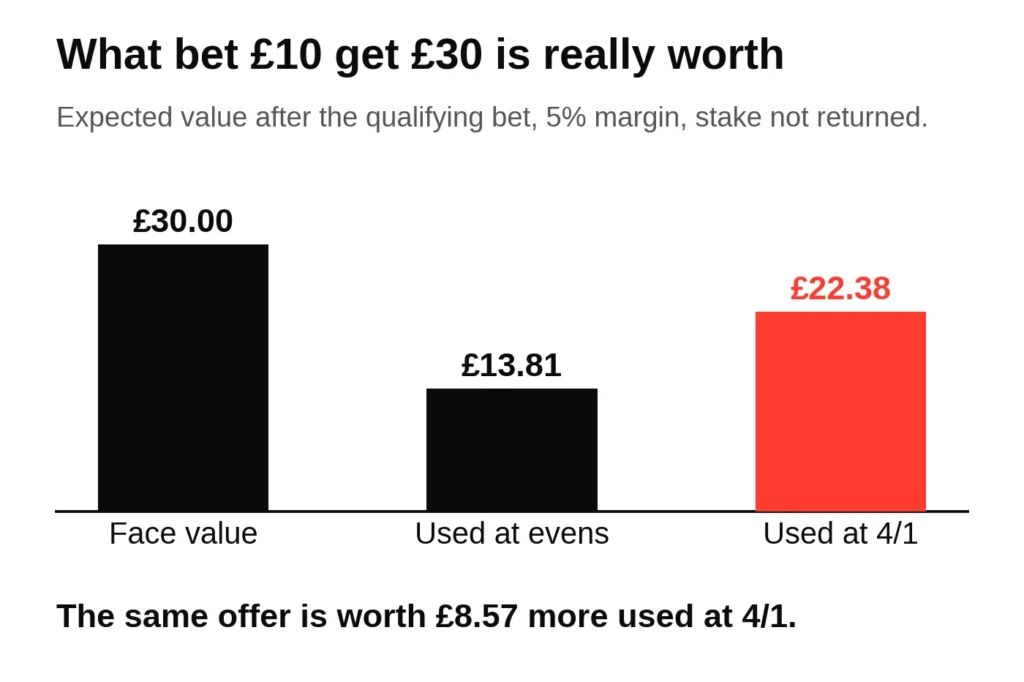
A headline like bet 10 pounds get 30 pounds tells you almost nothing on its own. We value every offer the same way, in expected pounds, and then look at what the book does once the offer has been used.
A free bet is a stake the book places for you. If it wins you get the winnings; if it loses you lose nothing of your own. In Britain almost every free bet is stake not returned, which means the free bet itself is never paid back, only the profit on it.
A 10 pound cash bet at 4/1 that wins returns 50 pounds: 40 pounds profit plus the 10 pound stake. A 10 pound free bet at 4/1 that wins returns 40 pounds, the profit only. That single difference is why a free bet is always worth less than a cash bet of the same size, and why the price you use it at matters so much.
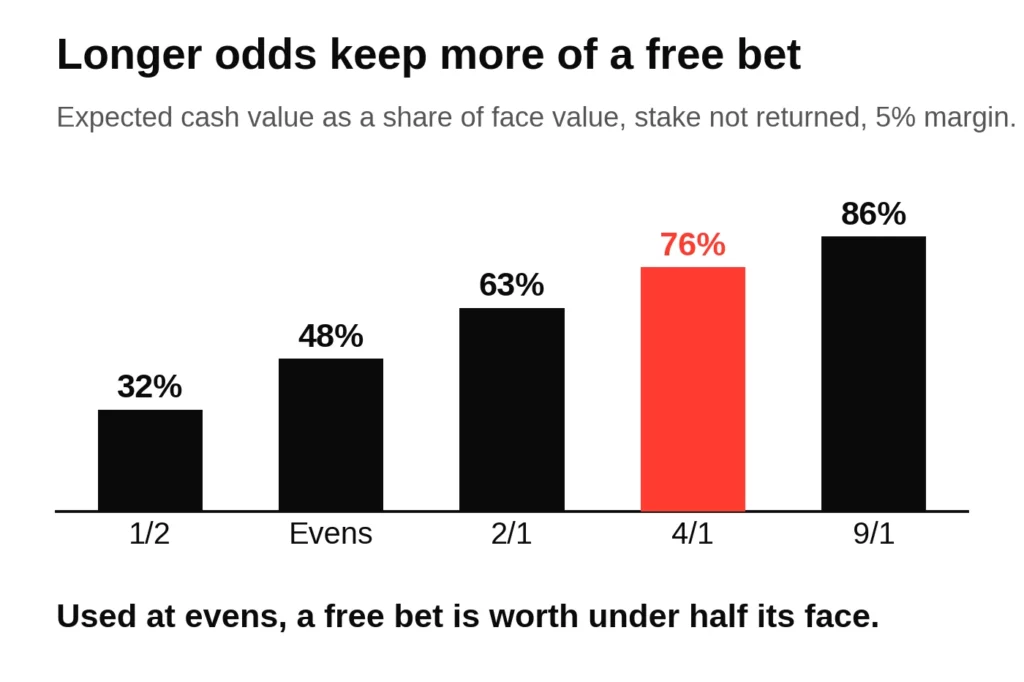
Because the stake never comes back, the value of a free bet depends on how much of the return is profit. At short odds most of a winning return would have been stake, so a stake-not-returned bet keeps little. At longer odds the profit is most of the return.
Put the two costs together. The qualifying 10 pound bet loses about 48p on average on a 5 per cent market, and the three 10 pound free bets are worth whatever the price you use them at allows.
The chart assumes the same 5 per cent margin at every price, and real markets do not work that way. Long prices usually sit in markets with many runners, where the margin built into the market is far wider. On a market with a 20 per cent margin, a free bet at 4/1 keeps about 67 per cent of its value instead of 76. The best use of a free bet is a longer price in a market that is still keenly priced, such as a football match result at 3/1 to 5/1.
Two offers with the same headline can be worth very different amounts once the terms are read. These are the terms that matter, and what each one does to the value.
| Stake not returned | Standard in Britain; the main reason a free bet is worth less than cash |
|---|---|
| Minimum odds | Sets the lowest price you can use the free bet at; a higher minimum keeps more of the value, but can force a bet you would not choose |
| Expiry | Often 7 days; a token you do not use in time is gone |
| Split tokens | Several smaller free bets instead of one; each must be used whole |
| Market restrictions | Some free bets can only be used on one sport or on accumulators |
| Payment method exclusions | Deposits by some e-wallets often do not qualify; debit cards usually do |
| Maximum winnings | A cap on what a free bet can pay, which cuts the value at long prices |
Most British sign-up offers are one of these shapes, and each rewards a different kind of bettor.
Place a qualifying bet, usually 5 or 10 pounds, and receive free bets whether it wins or loses. The most common shape, and worth more than a money-back offer of the same size because it pays whether the qualifying bet wins or loses.
Your first bet is matched with a free bet of the same size once it settles. If the match only applies when the first bet loses, it is a money-back offer under another name.
If your first bet loses, the stake is refunded as a free bet, which is worth less than a cash refund.
A small free bet for opening an account. Rare in Britain now, and usually hedged with low maximum winnings.
Free bets that can only be used on multiples, which ties the value to accumulator margins.
Extra free bets for betting through the app, which our guide to betting apps covers.
Claiming is simple, but most lost offers come from one of the same few mistakes.
Where you use a free bet changes its value as much as the price does, because every sport carries a different margin at the prices free bets are usually used at.
An offer is only free if it does not change what you would otherwise do. It costs you when it pushes you into a bet, a price or a book you would not have chosen. The book matters more than the offer, which is how we rank bookmakers: offers are judged on their terms, not their headline.
The sign-up offer is a one-off. What a book gives you after it is spent is worth more over a season, and it varies far more between books.
Offers from UK-licensed books look smaller and more alike than they did a few years ago, and rule changes are a large part of the reason.
Offshore books licensed outside Great Britain are not bound by those rules, set their own offer terms, and often run larger free bets and reloads for existing customers.
Books use offers to win customers, and they watch who takes them. An account that only ever uses free bets and boosts, or that pairs every free bet with a bet at an exchange to lock in its value, is often cut off from future promotions and sometimes limited on stakes. The practice of backing a free bet and laying it off is known as matched betting; it is legal, but books treat it as a cost. Our guide to why bookmakers restrict accounts explains what triggers a limit and what it does.
A free bet return is the stake times the decimal odds, minus the stake: a 10 pound free bet at 3.50 returns 25 pounds. For multiples and each way free bets the sum gets harder, and the bet calculator handles a stake-not-returned free bet like any other.
The best offer is the one you will actually use well.
The one whose offer is worth the most once its terms are applied, from a book that keeps giving value to existing customers. The ranking at the top of this page is built on both.
Almost never in Britain. A free bet is stake not returned: if it wins you receive the winnings only.
Very few. No deposit free bets are rare in Britain and are usually small, with a cap on what they can win.
Longer odds keep more of a free bet’s value, from about 48 per cent at evens to about 76 per cent at 4/1, as long as the market itself is keenly priced.
No. You can withdraw the winnings a free bet produces, but the free bet itself has no cash value.
Usually 7 days from being credited, sometimes less. An unused token expires and is lost.
Yes. Backing a free bet and laying it at an exchange is legal, but books treat it as a cost and often stop offering promotions to accounts that do it.
The biggest headline is not the best offer. Compare offers in cash: the free bet amount, the price you can use it at, the expiry and the qualifying bet. Some books add app-only free bets on top of the standard offer.
Often yes, and some free bets can only be used on multiples. Check the terms before you place the qualifying bet.