 By
By
Top Choice
1

Gamble Gorilla
- Exclusive Free Bet Offer
- In-Play Live Betting
- Broad Sports Coverage
Bonus
WELCOME SPORTS FREEBET
UP TO £100
FREEBET
UP TO £100
FREEBET

Horse racing
The best horse racing betting sites are the ones that take the smallest cut of a race, pay the best of your price and the starting price, and keep taking your bet once you start winning. We measured what the cut actually is across a full week of British and Irish racing, and ranked on that first.














Most racing rankings count features: streaming, offers, the number of meetings. We start with the price, because on a racing card the cut the book takes varies more than anything else and it comes out of every bet you strike. Then we check the things that change what a winning bet pays and whether the account stays open to strike the next one. Racing reweights the tests in our ranking of UK bookmakers, putting price first.
Add up the chance every price in a race implies and you get the overround, the book’s cut over a fair total of 100 per cent. We took the starting price book for every British and Irish race from 20 to 26 September 2026, 273 races at 24 courses and 2,697 runners, and measured it against the number of runners.
The pattern is almost mechanical. The starting price book runs at about 101 per cent plus close to 2 points for every horse in the field. A three-runner race carries a margin of around 8 per cent. A big handicap carries 35 per cent or more, and every runner you add is another couple of points taken out of the prices.
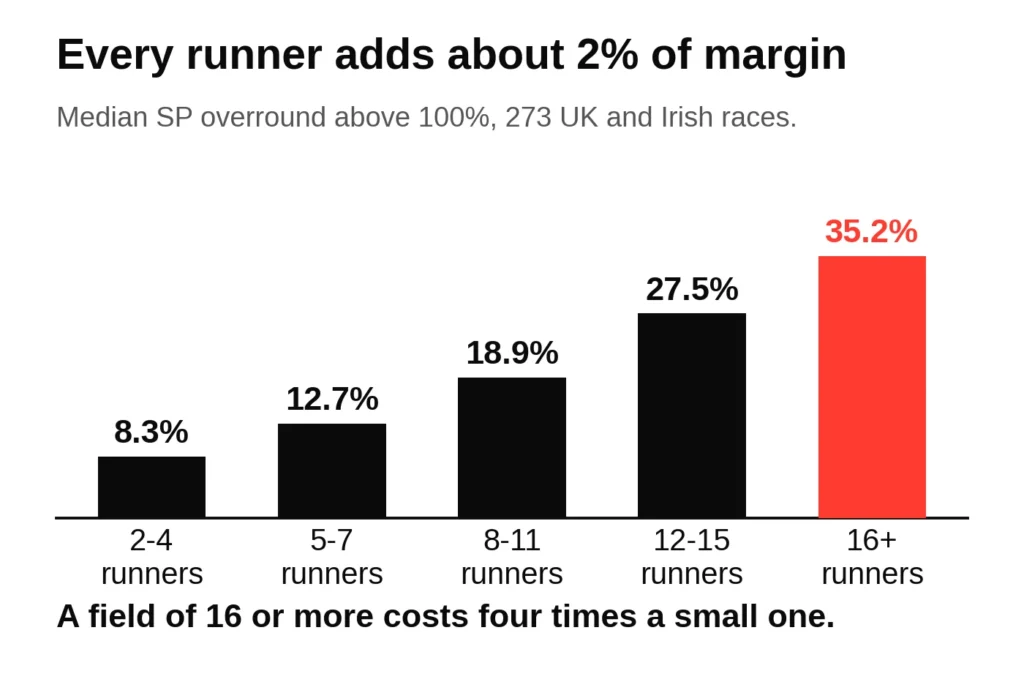
| 2 to 4 runners | 15 races. Median 108.3 per cent, a margin of about 8 per cent. |
|---|---|
| 5 to 7 runners | 65 races. Median 112.7 per cent. |
| 8 to 11 runners | 105 races. Median 118.9 per cent, close to the week-wide median of 119.2. |
| 12 to 15 runners | 73 races. Median 127.5 per cent. |
| 16 or more | 15 races. Median 135.2 per cent, more than four times the margin of a small field. |
| Handicaps against the rest | Handicaps ran a median of 119.2 per cent across 178 races, non-handicaps 118.0 per cent across 95. Field size, not race type, drives the number. |
A book has to price every horse, and in a big field most of them have little chance. Each outsider is priced shorter than its real chance deserves, because nobody complains about the price of a 50/1 shot, and those small shortfalls add up across a field of 20. The overround is the same arithmetic in every sport; racing simply has the most runners to spread it across.
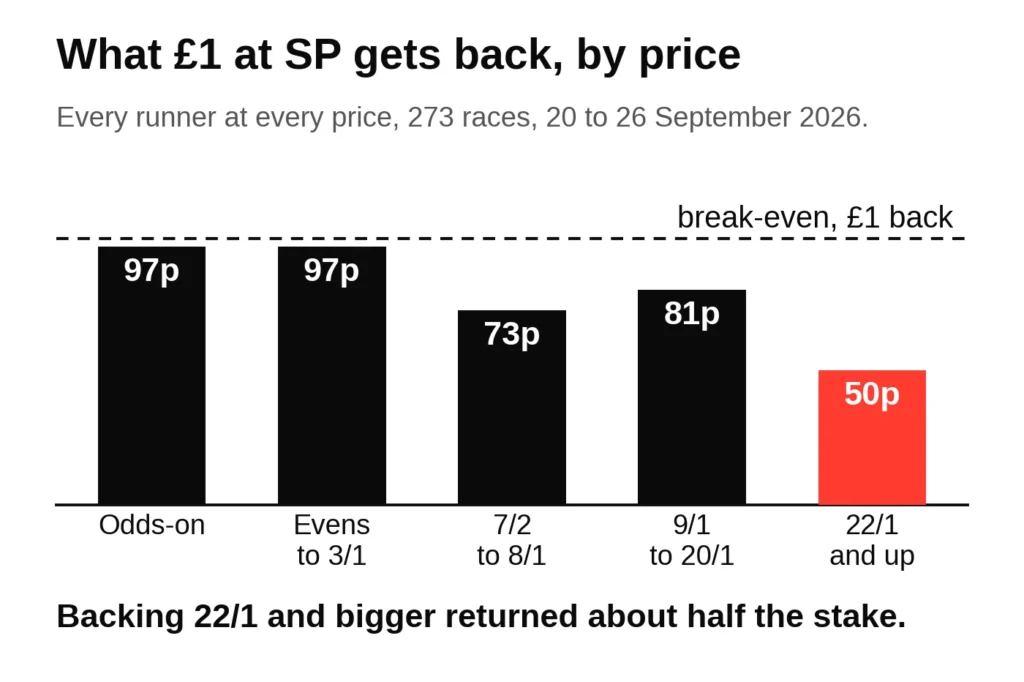
The overround is shared unevenly. Staking one pound on every runner at its starting price across the same 273 races shows where the cut really falls.
That is the favourite-longshot bias, and a week of racing shows it plainly. Shorter-priced horses were priced close to their real chance. Long shots were priced far shorter than theirs, and backing every one of them at the starting price lost half the stake. One week is a small sample at the long end, where 13 winners decide the figure, but the direction matches what racing data has shown for decades.
You can take a price at the time of the bet or settle at the starting price, the SP, which is set by the on-course market as the race starts. The two regularly differ by a lot, and in either direction: a horse backed heavily shortens, and one that goes unbacked drifts.
Best odds guaranteed removes the choice. The book pays the better of your price and the SP if the horse wins. It is the single most valuable racing concession, which is exactly why it has terms, cut-off times and a habit of disappearing from accounts that use it well. The full arithmetic of what it is worth is on best odds guaranteed.
Racing is where each way betting lives. Terms follow the field: two places at a quarter of the odds in small races, three at a fifth in bigger fields, and four at a quarter in the largest handicaps, with books adding extra places on the big races to compete. Because the place price is a fixed fraction of a win price that already carries the margin, terms and overround have to be read together. How each way betting works covers the terms and what they are worth.
A racecard carries more information than any other betting market, and most of it is free. Knowing what each line means is the difference between backing a name and backing a case.
None of it changes the price arithmetic above. It changes which horse you think the price is wrong about, which is the only reason to bet at all.
British racing runs two codes on overlapping calendars. Flat racing on turf runs from spring to autumn, with all-weather racing through the winter; jumps racing, over hurdles and fences, peaks from November to April. The betting is different in each.
Flat fields are often bigger, and on the field-size figures above a bigger field means a wider margin; on the flat the draw matters too. Jumps races carry the risk of falls and pulled-up runners, which makes each way and non-runner concessions worth more, and the big jumps meetings, Cheltenham and Aintree, drive more ante-post betting than anything on the flat.
The racing slip carries bet types no other sport uses as heavily, and each has its own settlement quirks.
Multiples and each way multiples multiply the stake as well as the return, and racing’s settlement rules change the arithmetic. You can settle any racing multiple in the calculator before you place it.
A horse withdrawn before the race is a non-runner and a bet on it is void. If it goes late, after the market has formed, the remaining prices are too long for the smaller field, and winning bets on the others are reduced by a Rule 4 deduction scaled to how short the withdrawn horse was. The deduction comes off winnings, not the stake.
Non-runner no bet is the concession that matters most in ante-post markets, weeks before a big race: without it, a stake on a horse that never runs is lost. Books offer it on the major festival races as the declarations approach.
Racing is bet in running on the exchanges, where prices trade during the race itself and a horse can be backed or laid as it moves through the field. It is the fastest market in sport, and delays, latency and suspensions matter even more than they do on football, which is covered in full on live betting.
Most racing books stream British and Irish meetings, and the condition for watching is usually the part that matters: a funded account, a bet placed on that race, or a minimum stake. The picture runs several seconds behind the course, which is harmless for watching and costly for betting in running.

Racing carries more running promotions than any other sport, and they are worth reading as prices rather than as gifts. The value is in the terms, and the terms decide who can use them.
The offers on racing free bets are measured the same way, by what they return against what they cost to unlock.
Racing is one of the places British-licensed books watch their customers most closely, because it is where early prices and starting prices diverge and where a punter who takes early prices well can beat the SP. The Gambling Commission counts a withdrawn betting facility as a restriction in its own right, on 19 per cent of restricted accounts, and on racing the facilities worth withdrawing are the price concessions. The data on how bookmakers limit accounts shows how common and how deep the cuts are.
Books licensed outside Great Britain work to a different commercial model and do not cut stakes or withdraw concessions in the same way or at the same speed, which is the reason the ranking on this page looks the way it does.
Racing runs every day of the year, but the betting markets, the concessions and the extra places cluster around the major meetings. Ante-post markets on them open months early.
The right book depends on what you back and how often.
The one with the smallest cut on the races you bet, best odds guaranteed on the races you bet them on, and a record of keeping winning accounts open. The ranking above is built on those.
Choose a race and a horse, pick win or each way, take the price on offer or the starting price, and enter the stake. A win bet pays if the horse wins; an each way bet also pays if it places.
It depends on the field. Across a week of British and Irish racing, the SP book ran at a median of 108 per cent with four or fewer runners and 135 per cent with 16 or more. Compare a book with the starting price on the same race.
With best odds guaranteed you get the better of the two on a winner, so take the price. Without it, it depends on whether you think the horse will shorten or drift before the off.
Books price outsiders shorter than their real chance, and the overround falls most heavily on them. In one week of racing, backing every 22/1 or bigger runner at SP returned about half the stake.
It is void and the stake is returned. If another horse is withdrawn late, a Rule 4 deduction may reduce the winnings on your bet.
A concession on ante-post markets that returns your stake if the horse does not run, instead of the stake being lost.
There is no system that beats the overround on its own. The bets that pay over time are the ones where your view of a horse is better than its price, taken at the best price on offer, with best odds guaranteed where the book allows it, and struck on shorter prices in smaller fields, where the cut is smallest.
Most racing books stream British and Irish meetings, usually to accounts that are funded or have a bet on that race.